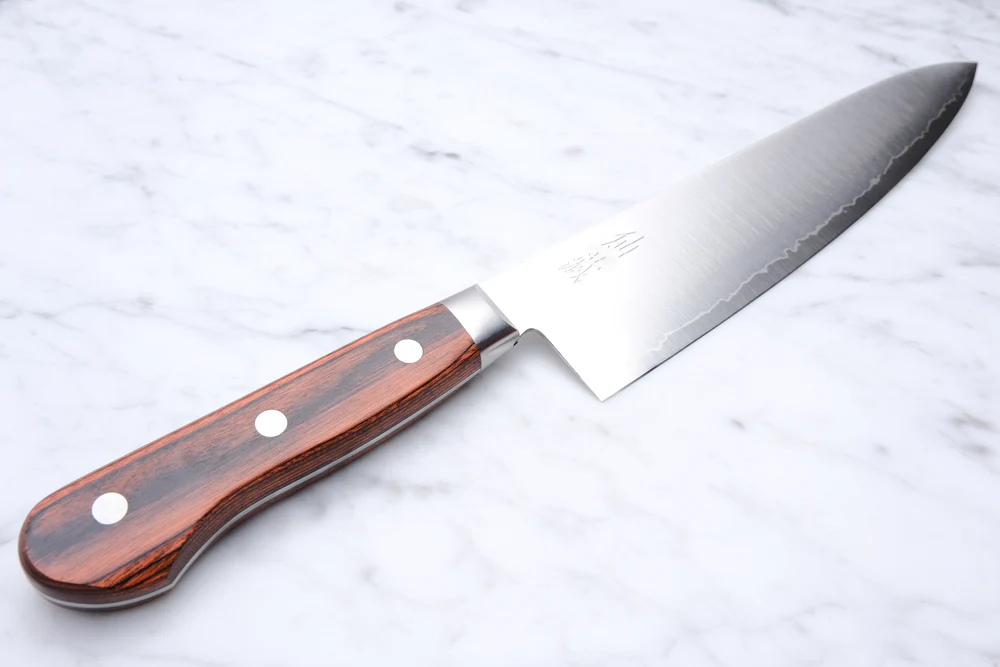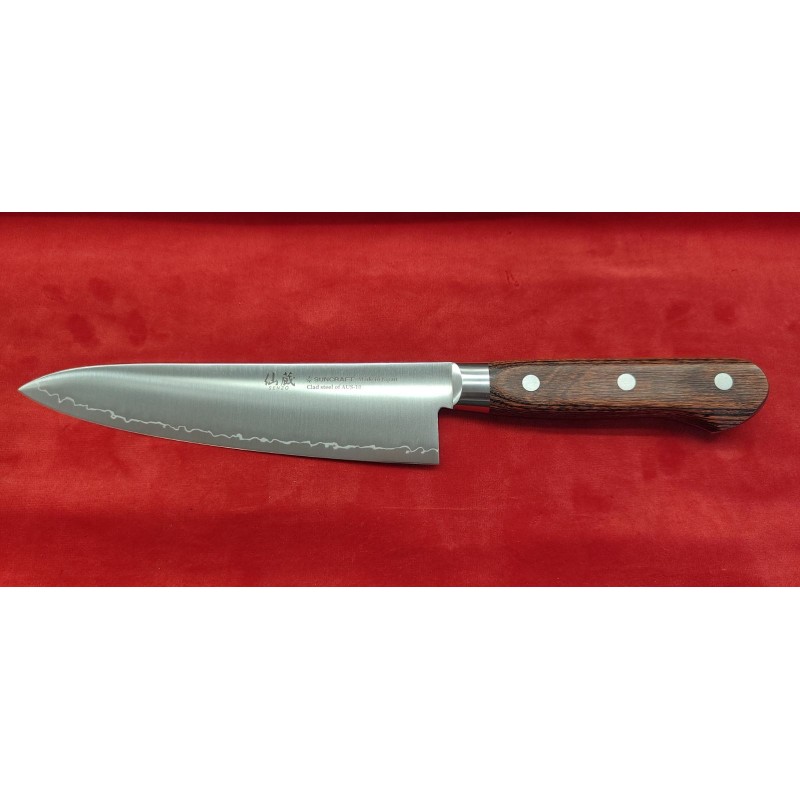
If you are looking for a Japanese kitchen knife with an excellent price-to-quality ratio, the Senzo Clad series is the perfect choice. These knives are made from high‑quality Japanese stainless AUS10 steel with a fine grain structure, featuring a beautiful, ergonomic handle and superb craftsmanship.
The blade, shaped in the traditional Gyuto style, is crafted from a three‑layer (San Mai) laminate with an AUS10 high‑carbon steel core, hardened to 60 HRC and hand‑sharpened on a water wheel.
The handle is made of brown Pakka wood in a Western full‑tang style, reinforced with three stainless‑steel rivets and finished with a stainless bolster that transitions smoothly into the blade. Its shape is designed to provide comfort and perfect control.
These elegant and cleanly designed Japanese kitchen knives deliver excellent performance at a moderate price. They feature precise fit and finish, are well‑balanced, and offer exceptional value for their quality. Unlike many other Japanese knives, they are easy to maintain with a honing rod or Japanese whetstone. The Senzo Clad series is a beautiful addition to any home kitchen or professional chef’s toolkit.
Light, sharp, and comfortable — just like every authentic Japanese kitchen knife.
✅ Proper Maintenance
Hand wash the knife with warm water and dry it immediately with a soft cloth to preserve its sharpness and material integrity.
For long-term precision, use whetstones for sharpening, while ceramic honing rods are excellent for fine edge adjustment during use.
Always store the knife properly to avoid contact with other kitchen tools and potential damage.
Use wooden, plastic, or rubber cutting boards, which are gentler on the edge and help extend the blade's lifespan.
⚠️ Special Note on Traditional Japanese Steels
Japanese knives with high-carbon steel blades require special care to prevent oxidation and rust formation.
After each use, wash thoroughly with warm water and dry immediately with a soft cloth.
Occasionally apply a thin layer of mineral or camellia oil to the blade for added corrosion protection.
Store knives in a dry place, avoiding prolonged exposure to moisture or contact with aggressive cleaning agents.
? What to Avoid
Do not use the knife on hard surfaces such as glass, ceramics, steel, metal tables, or baking trays.
Do not cut bones or frozen ingredients, as this can damage the edge.
Do not wash the knife in a dishwasher — chemicals and high temperatures can compromise the blade and handle.
A Japanese knife is a precision instrument designed for specific culinary tasks. Do not use it for unsuitable activities such as cutting bones, opening cans, or working with hard materials.
Send request